Tachycardia | Healthcare Spanish
 Written by Evelin Maza
 Reviewed by Judy Haluka
Changes: Fixed HTML structure, corrected Spanish accents, and improved alt text
Why give us your email? We'll send you common Spanish healthcare phrases straight to your inbox along with other helpful resources. We respect your privacy and won't share your information.
In this issue
- Terms and chart related to tachycardia
Learning on the go!
The goal of this newsletter is to provide you with enough information to be useful, but not more than can be learned within the busy schedule of a health care worker. You’ll find anatomy charts, additional vocabulary, occasional feedback from subscribers, and more! Feel free to read them now and save them for later use such as with a patient or as a study guide for coursework.
Vocabulary
- Tachycardia or tachyarrhythmia
- Supraventricular tachyarrhythmia
- Sinus arrhythmia
- Atrial arrhythmia
- Junctional arrhythmia or nodal arrhythmia
- Beats per minute
- Pulse
- Ventricular arrhythmia
- Heart beat between 100 and 150 is called simple tachyarrhythmia
- Heart beat between 150 and 200 is called paroxysmal tachyarrhythmia
- Heart beat between 250 and 350 is called flutter (atrial or ventricular)
- Heart beat over 350 is called fibrillation
- Taquicardia o taquiarritmia
- Taquiarritmia supraventricular
- Arritmia sinusal
- Arritmia auricular
- Junctional arritmia o arritmia nodal
- Latidos por minuto (LPM)
- Pulso
- Arritmia ventricular
- Latido del corazón entre 100 y 150 LPM se llama sencilla taquiarritmia
- Latido del corazón entre 150 y 200 LPM se llama taquiarritmia paroxística
- Latido del corazón entre 250 y 350 LPM se llama aleteo (auricular o ventricular)
- Latido del corazón más de 350 LPM se llama fibrilación

Nodal reentry tachycardia—taquicardia por reentrada nodal
English description
In typical AV nodal reentrant tachycardia (slow antegrade conduction via the slow pathway and retrograde conduction via the fast pathway), the P wave is not visible and may appear right after the QRS complex, resembling a pseudo R wave in lead V1.
Descripción en Español
En la taquicardia por reentrada nodal típica (conducción anterógrada por la vía AV lenta y conducción retrógrada por la vía rápida), la onda P puede no verse y puede ser visible justo después del complejo QRS, pareciendo una pseudo R en la derivación V1.
Need CPR this year? Take English and Spanish together: you get the certification course and the Spanish twin in the same cart. Spanish is free when English CPR is in the cart.
Word practice pages




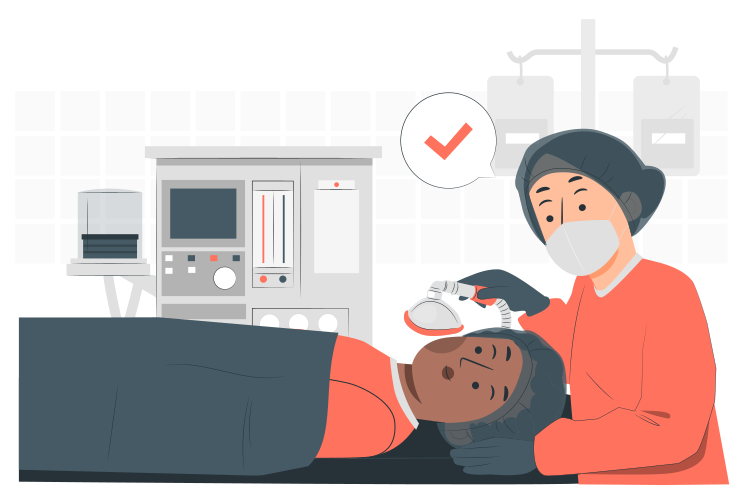


Monitor technician
Learn healthcare spanish phrases used as a monitor technician in spanish.
Go to practice
Pharmacy technician
Learn healthcare spanish phrases used as a pharmacy technician in spanish.
Go to practiceHelp others by providing feedback
Part of Health Care Spanish’s mission is to create a useful resource for health care workers. However, there is only so much that can be done without feedback from you. Email questions or suggestions to support@PacificMedicalTraining.comEmail.
Tell us if there is a topic you want us to cover or a resource we can add to the site.
How we reviewed this article
Our experts continually monitor the medical science space, and we update our articles when new information becomes available.
- Current versionMail the author of this pageEmail
- Jul 17, 2026
Copy edited by:
Copy editorsChanges: Fixed HTML structure, corrected Spanish accents, and improved alt text- Feb 18, 2021
Reviewed by:
Judy Haluka Judy has helped write or review several medical publications for us. Everything that she works on will clearly include Judy’s name.- Oct 21, 2015
Written by:
Evelin Maza Evelin Mercedes Maza Guia is a physician from the University of Oriente in Anzoátegui, Venezuela.